Last week, the “Brazilian Cinema for Everyone” project, organized by Ancine in partnership with the National Secretariat for the Rights of Persons with Disabilities, took students with visual and hearing impairments from public schools in the Federal District to accessible screenings of the film *Chico Bento and the Marvelous Guava Tree*, by Maurício de Sousa.
The screenings took place at Cinesystem in Guará and featured audio description, Brazilian Sign Language (Libras), and descriptive captions, ensuring that everyone could laugh, be moved, and understand the story on an equal footing. For many students, it was the first time they were able to experience the movies in a truly inclusive way, without relying on explanations afterward or on individual interpreters.
This initiative demonstrates, in practice, that accessibility is not a privilege—it is a right. It broadens cultural horizons, strengthens the autonomy of people with disabilities, and reaffirms the importance of making Brazilian audiovisual content accessible to everyone.
Since 2023, all movie theaters in the country have been equipped with accessibility solutions. The technology is available—but there is still a need to make progress in terms of outreach, usability, and public policies that ensure the full use of these resources.
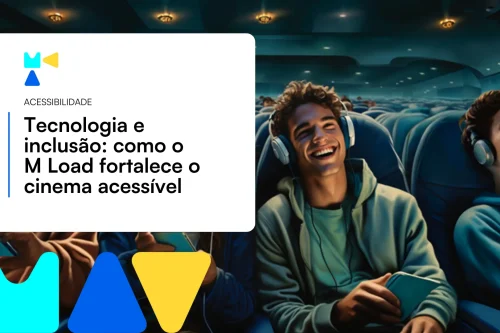
Among these solutions is M Load, an app that offers closed captions, Brazilian Sign Language (Libras), and real-time audio description. Distributors upload the accessibility files to the cloud, where users can download them for free onto their own devices and access them at any movie theater in the country. In many cases, it is also possible to synchronize the audio with the accessibility feature.

With this, M Load reaffirms MAV’s commitment to creating an inclusive ecosystem in which technology serves as an ally, enabling everyone to fully experience the magic of the movies.
At MAV, we believe that initiatives like this are a milestone for inclusion in the audiovisual sector. We are committed to continuing to promote barrier-free accessibility and supporting initiatives that transform the cultural experience into a truly collective space.
📎 Read the full article in Correio Braziliense: The “Brazilian Cinema for Everyone” Project Promotes Accessibility